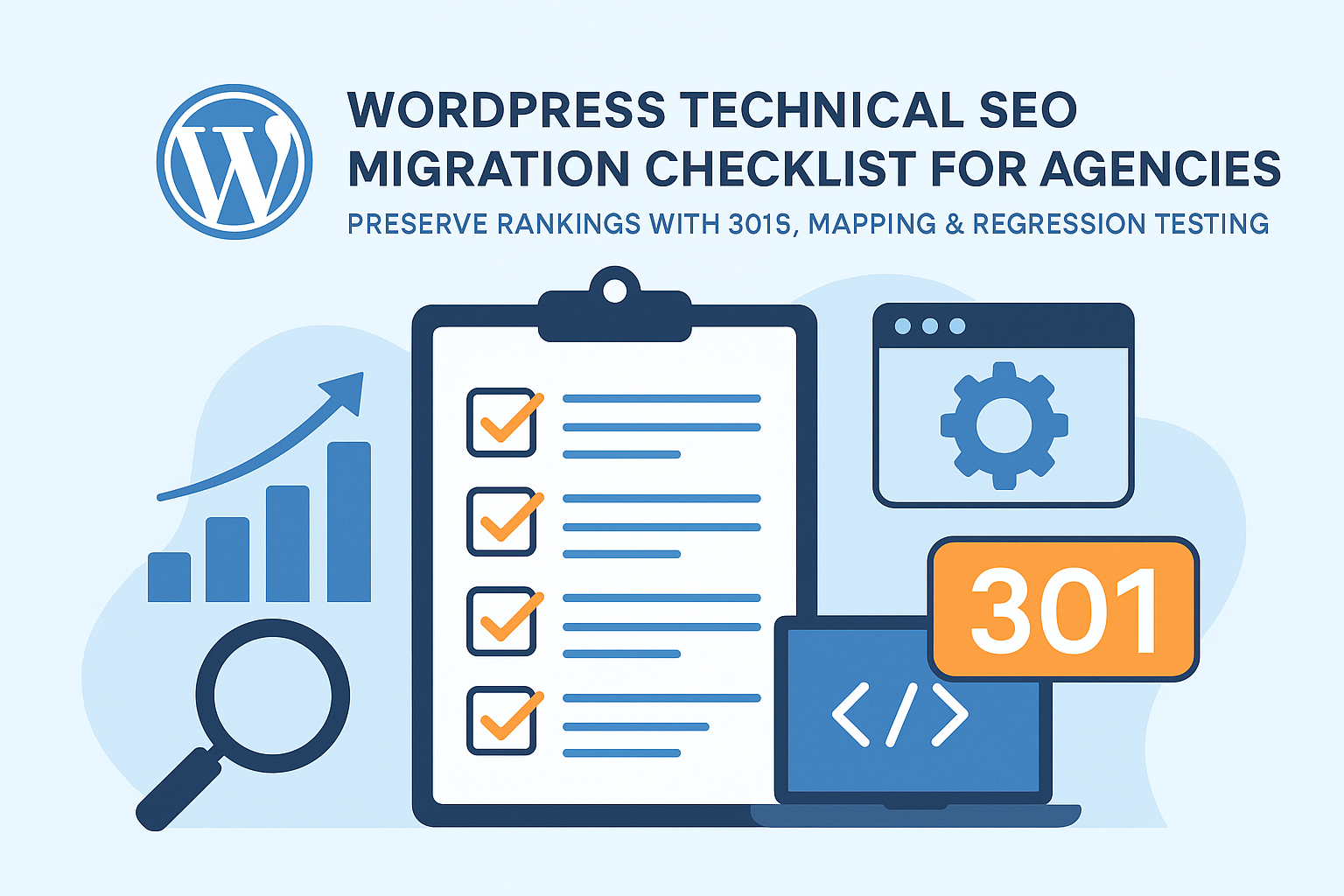
A repeatable WordPress migration checklist for agencies: redirect mapping, sitemap/hreflang, canonical verification, crawl error fixes, and SEO regression testing.
 by Rizwan
WordPress migration failures rarely come from “moving content.” They come from losing URL intent: the old URLs stop resolving correctly, signals like canonicals and hreflang drift, and search engines discover new pages before the redirects and indexation rules are ready.
In agency work, the goal is simple: preserve rankings by controlling URL rewrites, redirect mapping, indexation, and crawl behavior from day one. This article gives you a repeatable migration checklist that you can run for every client, every time.
Treat every migration like a release. You need a staging checklist, a pre-launch validation pass, and an SEO regression testing step that compares “before vs after” indexation and crawl outcomes.
Redirect mapping is the backbone of ranking preservation. Create a mapping document that ties every old URL to its final destination and expected server response code.
Common mistake: generating redirects from a sitemap export that misses URLs discovered via internal links, backlinks, or search results. Your mapping must include the URLs that actually matter.
Before you migrate, audit the current site’s SEO behavior so you can reproduce it accurately on the new WordPress build. This is where a theme/plugin audit prevents “silent” template changes.
For each key template (home, landing pages, blog posts, category pages, product pages, and legal pages), record:
This becomes your “diff checklist” during SEO regression testing.
Staging is where most agencies lose time and rankings. If staging gets indexed, you create duplicate content and crawl waste. Your staging checklist must prevent indexation while still allowing internal QA.
Pick representative URLs for each bucket in your redirect mapping:
Then test them in staging for correct destination, correct canonical verification, and correct server response codes.
Execution is where technical SEO becomes operational. The order matters: redirects and indexation rules must be ready before you invite search engines to crawl.
When you implement redirects, enforce these principles:
Practical example: if you migrate from /services/slug/ to /solutions/slug/, do not redirect /services/slug/ to /solutions/slug/preview/ and then later to /solutions/slug/. That chain adds crawl waste and delays signal consolidation.
WordPress migration often includes permalink changes. If you change permalink structure, you must align:
Common mistake: changing permalink structure without updating internal link templates, leaving internal links pointing to old patterns that now 404.
XML sitemaps are not just for discovery; they influence crawl patterns. Your sequencing should be:
Do not submit a sitemap that includes URLs you have not validated for canonical verification and indexation rules.
Canonical verification and hreflang are where “almost right” causes real ranking loss. Search engines treat canonical and hreflang inconsistently when signals conflict.
Canonical verification should confirm:
Practical example: if your SEO plugin sets canonicals based on request URL, and you test old URLs after redirects, you may accidentally generate canonicals that point to the old URL. That can cause indexation conflicts.
For hreflang, validate that:
Common mistake: migrating localized slugs but forgetting to update hreflang targets, leading to incorrect locale routing and indexation fragmentation.
After cutover, you need a tight loop: crawl errors, broken links, and server response codes. This is where rankings stabilize-or keep declining.
Use Search Console to watch for:
Do not wait for “next month’s report.” Your first 72 hours determine how quickly you eliminate crawl waste.
Broken links are not just user experience issues; they create crawl waste and weaken internal link flow. Your approach:
Common mistake: relying only on redirects while leaving internal links pointing to old URLs. Redirects work, but internal linking should be updated to reduce crawl overhead.
For each critical URL category, confirm the expected server response codes:
When response codes are wrong, crawlers and users see different realities than your QA browser does.
SEO regression testing is the step agencies often skip because it feels redundant. It is not redundant. It is how you catch template differences, canonical drift, and indexation changes before they become ranking loss.
Create a matrix that compares “before vs after” for:
Then test the same URLs using the same user agents and follow redirects to confirm final HTML matches expectations.
Use a practical set of checks:
Key takeaway: your goal is stable indexation, not just “pages load.”
Below is a production-ready checklist you can reuse as a migration runbook. Assign owners (SEO, dev, QA) and require sign-off before cutover.
If you need deeper debugging, pair this checklist with technical SEO debugging using server logs to eliminate crawl waste and confirm bot behavior.
Fix: update internal link generation in templates and page builders, then re-run broken links checks.
Fix: ensure canonical generation uses final URL logic and does not rely on request path when redirects are involved.
Fix: validate every locale pair and ensure language URLs match final URL rewrites.
Fix: sequence sitemap submission after redirect mapping and canonical verification are complete.
Fix: lock templates during the cutover window and document theme/plugin audit decisions.
You do not need a complex stack to run this checklist, but you do need consistent evidence. Use your existing SEO tooling plus Search Console for crawl truth.
If you want to automate reporting so the team sees issues faster, use AI automation for SEO reporting to keep coverage and crawl signals current.
Ready to start your project? Let's work together to make it happen! Get in touch with us today and let's bring your ideas to life.
Get In Touch