Build a repeatable SaaS SEO content ops workflow that uses AI for drafts while enforcing technical accuracy, E-E-A-T, and structured data checks.
 by Rizwan
SaaS teams adopt AI drafts to ship faster, then lose rankings because the content pipeline has no enforcement layer for technical accuracy. The result is predictable: wrong claims, inconsistent entity coverage, broken internal links, and structured data that fails schema validation.
Content operations must treat SEO writing like production engineering. You need an editorial QA system that validates facts, checks canonical rules, verifies schema markup, and measures performance KPIs against an update cadence. AI drafts accelerate drafting; your workflow guarantees correctness.
Repeatable content ops is not “use a prompt and hope.” It is a defined sequence of inputs, automated checks, human review gates, and documented outputs that stay consistent across product pages, landing pages, guides, and changelogs.
In practice, you standardize:
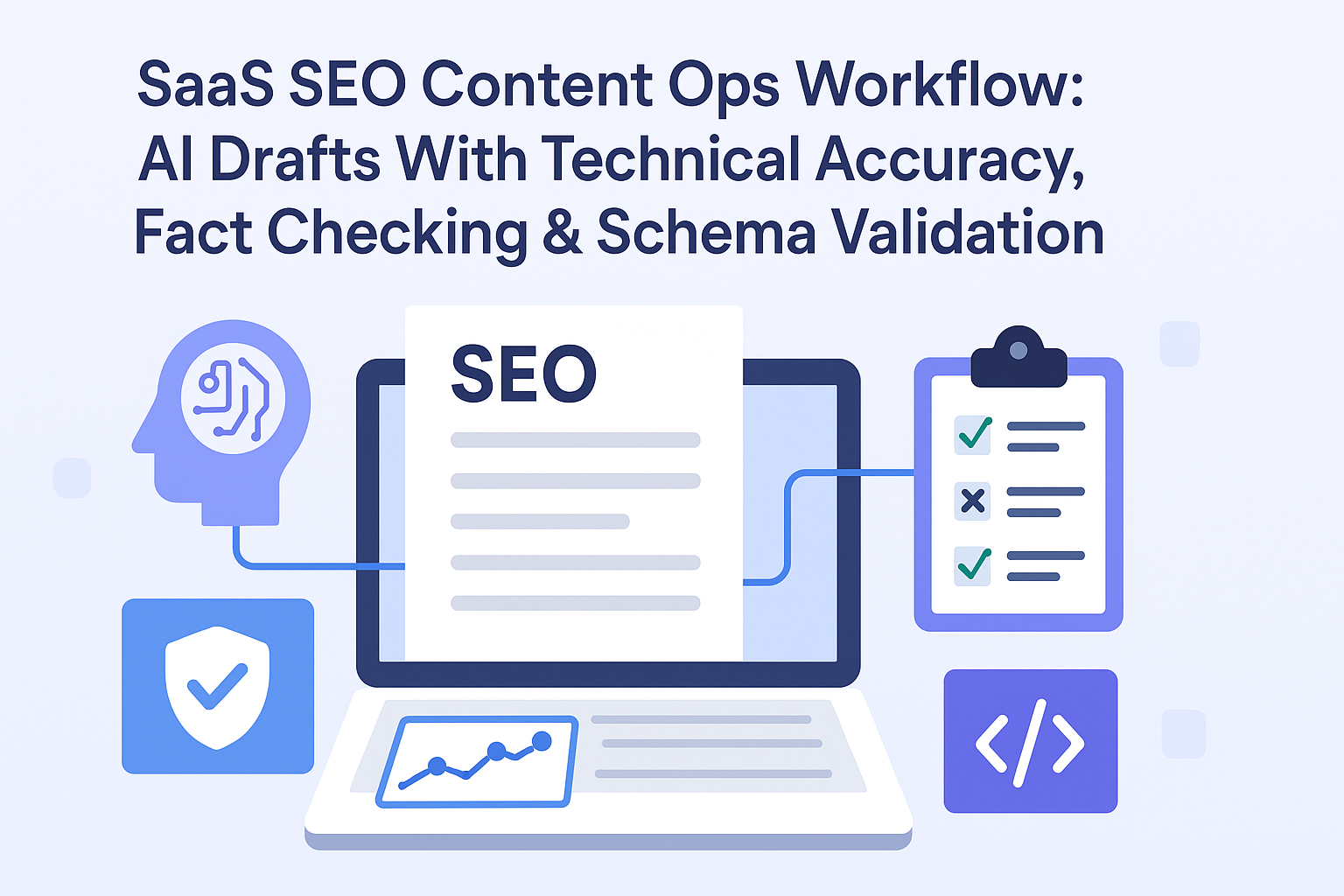
Use a three-lane workflow: AI drafting, technical validation, and editorial QA. Each lane has explicit gates. If a gate fails, the item returns to the correct stage-never straight to publishing.
AI drafts are only as good as the content brief templates you feed them. Your brief must include the target intent, required entities, constraints, and the exact technical context the writer must not violate.
Minimum brief fields that work for SaaS:
Generate AI drafts to produce structure, first-pass wording, and section coverage. Then enforce guardrails before anyone edits for polish.
Guardrails you should implement:
Rule: AI drafts can propose content, but they cannot be the source of truth.
Editorial QA is where you enforce E-E-A-T through verifiable authoring, consistent terminology, and documented sources. Technical accuracy is where you enforce schema validation, canonical rules, and internal links that match the site architecture.
Use a checklist that is identical for every piece, then add page-type-specific checks.
Most SaaS SEO content failures are not “bad writing.” They are incorrect statements, missing context, or entity mismatches that confuse users and search engines. Your workflow must explicitly handle fact checking and entity coverage.
Before final edits, extract claims from the draft and map each claim to a source. This can be manual at first, then partially automated with rule-based extraction.
For each claim, record:
If a claim has no source, it must be removed or rewritten to a verifiable statement. This is the fastest way to protect technical accuracy and E-E-A-T.
Entity coverage means the draft includes the right concepts and relationships, not just keywords. For SaaS, entities often include plan names, feature names, integration names, deployment modes, and limitations.
Create a taxonomy table and require it in briefs. Then validate that the draft uses the canonical entity names.
Common mistake: letting writers invent synonyms for plan names. That creates inconsistent entity signals and makes internal linking harder.
Structured data is not optional for SaaS content ops. When you publish without schema validation, you risk losing rich results eligibility and you create inconsistent entity signals across pages.
Do not “spray JSON-LD everywhere.” Choose schema types that match the page’s purpose and content. For B2B SaaS, typical schema includes Product, SoftwareApplication, and FAQ when the page contains qualifying Q&A.
For a scalable schema strategy, align your markup with schema strategy for B2B SaaS at scale using Product, SoftwareApplication & FAQ markup.
Schema validation must happen as a gate, not as a post-launch cleanup. Your workflow should check:
When schema validation fails, route the item back to the technical editor. Do not “ship anyway.”
Technical SEO mistakes inside content ops are expensive because they compound. A wrong canonical rule can consolidate signals incorrectly. Broken internal links waste crawl budget and reduce topical reinforcement.
Every page type has canonical rules. For SaaS, canonical issues often appear in filters, sorting, multi-tenant URLs, and landing page variants.
Use a dedicated canonical QA step and reference your canonical rules documentation. For Laravel-specific patterns, see canonical rules to prevent duplicate content in Laravel apps.
Internal links should be intentional and consistent with your site architecture. AI drafts can propose link targets, but your workflow must enforce internal links that match the correct page type and avoid linking to noindex or unstable variants.
To operationalize this, generate and maintain an internal link map from real crawl and GSC data. A practical approach is covered in SaaS SEO automation with AI to auto-generate internal link maps from GSC + crawl data.
Before publish, verify:
Content brief templates are the control surface of content operations. They reduce variance between writers, agencies, and internal teams. They also make AI drafts more reliable because the model is constrained by your acceptance criteria.
Use a template that includes both SEO and technical requirements:
Define pass/fail criteria for each gate. Example acceptance criteria:
SaaS SEO content ops fails when it treats publishing as the end. You need an update cadence that ties content refreshes to performance KPIs and product changes.
Not all pages require the same review frequency. Use a simple risk model:
Then schedule reviews accordingly. Tie updates to release notes and deprecations so technical accuracy stays intact.
Performance KPIs should include both visibility and technical outcomes. Use a dashboard that combines:
When KPIs drop, run editorial QA and technical QA before rewriting. Many declines are caused by canonical issues, internal link drift, or outdated facts-not by insufficient writing.
AI drafts reduce time-to-first-draft, but they also increase the chance of shipping incorrect content if your gates are weak. These are the failure modes I see most often in SaaS and WordPress/Laravel ecosystems.
Fix: enforce fact checking with a claim register and require source mapping for every non-trivial claim. If it cannot be sourced, it is removed.
Fix: maintain a taxonomy and validate entity coverage in drafts. Writers must use canonical names for features, plans, and integrations.
Fix: schema validation gate plus URL matching to canonical rules. Structured data must reflect the final published content, not the draft.
Fix: internal link map enforcement and editorial QA for link integrity. Avoid linking to unstable filter/sort variants that can create duplicate content signals.
Fix: schedule refreshes based on volatility and tie them to product releases. Technical accuracy is maintained through continuous review, not one-time publishing.
Start small, then scale. The goal is to get one repeatable pipeline running end-to-end with measurable quality improvements.
Ready to start your project? Let's work together to make it happen! Get in touch with us today and let's bring your ideas to life.
Get In Touch