Learn a human-in-the-loop Topic→Outline→QA workflow for SaaS content ops, with editorial QA, fact checking, and SERP analysis.
 by Rizwan
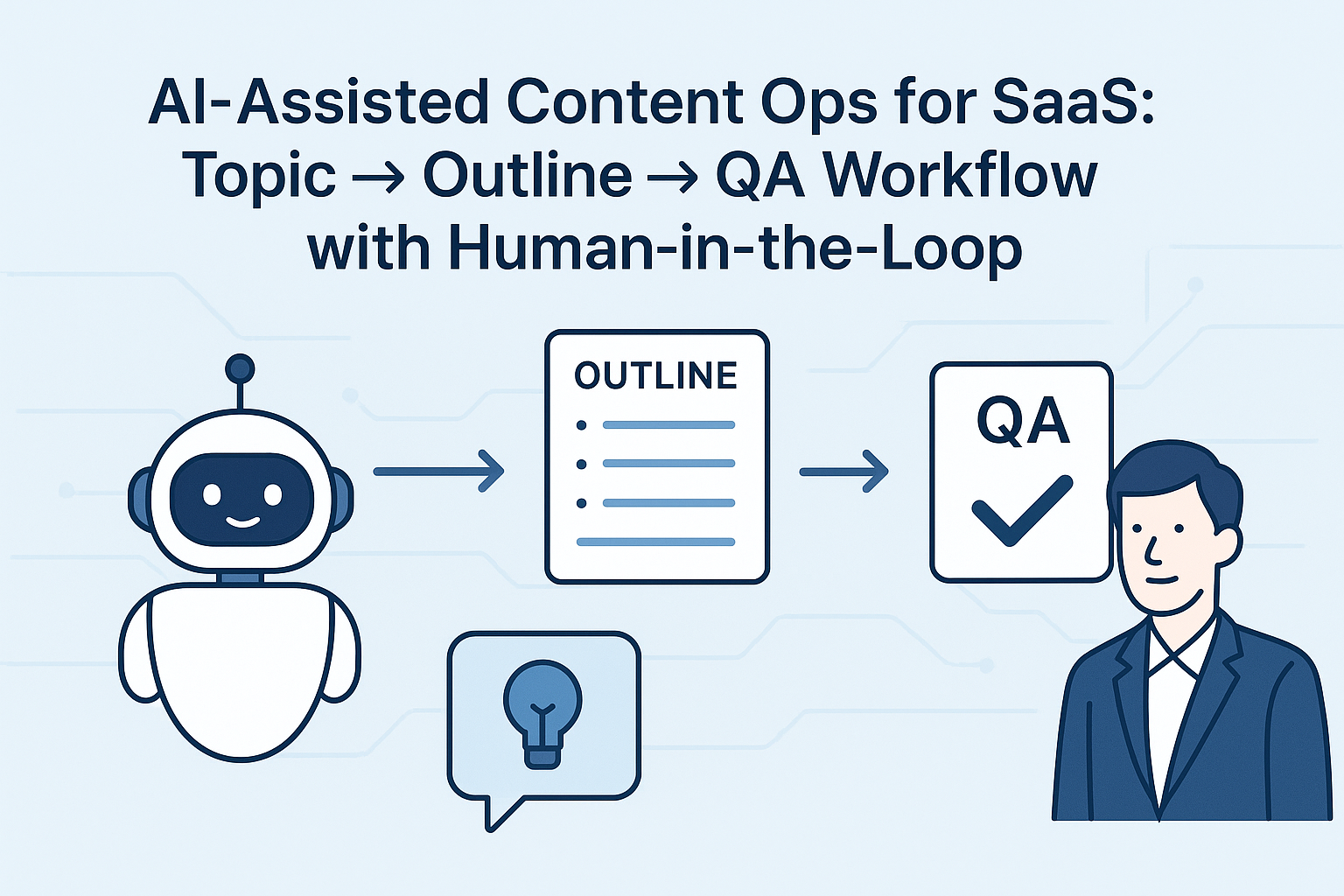
SaaS content teams are shipping faster than ever, but search performance still depends on editorial QA, fact checking, and E-E-A-T signals. The winning operational shift is a Topic→Outline→QA workflow where LLM workflows draft, then human review validates intent, accuracy, and brand voice constraints. This news-style playbook explains what to implement now and why it changes outcomes for technical SEO and conversion mapping.
Pro Tip: Treat AI output as a staging environment. Your editorial QA checklist is the production gate that protects rankings.
Search engines reward consistency across SERP analysis, content clustering, and internal linking suggestions, not raw volume. AI-assisted content ops now enables repeatable LLM workflows for briefs, outlines, and first-pass drafts, but only human review can enforce knowledge base reuse and brand voice constraints at scale. The operational impact is measurable: fewer factual errors, tighter topical coverage, and faster iteration cycles across the content brief lifecycle.
Instead of asking an LLM to “write an article,” teams should run a controlled pipeline that produces structured artifacts. The pipeline starts with a content brief, generates an outline aligned to SERP analysis, then executes editorial QA checklist steps for fact checking, duplicate detection, and E-E-A-T signals. This structure also supports conversion mapping by tying each section to product intent and funnel stage.
Start with a topic selection step that uses SERP analysis to confirm demand and identify content clustering opportunities. Your system should output a topic hypothesis, primary keyword, supporting entities, and a mapping to adjacent pages to prevent cannibalization. This is where internal linking suggestions are planned before writing begins.
For SaaS, topic selection must also reflect product capability and onboarding intent. Your workflow should require a conversion mapping field that states which feature, page, or onboarding step the article supports.
Outline generation should be deterministic and structured, not free-form. Use LLM workflows to convert the content brief into an H2/H3 plan that mirrors SERP patterns while enforcing your brand voice constraints. The outline must include claim placeholders that later feed fact checking and knowledge base reuse.
Warning: If your outline lacks claim placeholders, your fact checking step becomes a manual rewrite.
| Outline Element | Required Field | QA Dependency |
|---|---|---|
| H2 sections | Intent alignment + entity coverage | SERP analysis verification |
| H3 subsections | Claim list + examples | Fact checking and knowledge base reuse |
| Internal link slots | Anchor intent + target page | Internal linking suggestions validation |
| CTA blocks | Conversion mapping target | Editorial QA checklist |
Drafting should follow prompt templates that constrain tone, structure, and evidence requirements. Immediately after drafting, run content scoring to quantify completeness, claim coverage, and alignment to the content brief. This step reduces human review time by filtering low-quality outputs early.
Content scoring must also include duplicate detection checks against your existing knowledge base and site pages. When the system detects overlap, it should trigger a revision request that changes angle, examples, or entity coverage rather than simply rewriting.
| Score Dimension | Option A: Strict | Option B: Lenient |
|---|---|---|
| Claim coverage | All claims mapped to sources | Some claims left uncited |
| Brand voice constraints | Enforced tone + terminology | Minor deviations allowed |
| Duplicate detection | Hard block on cannibalization | Soft warning only |
| E-E-A-T signals | Author + proof required | Proof optional |
Human review must execute an editorial QA checklist that validates accuracy, evidence, and E-E-A-T signals. The checklist should require source verification for every high-impact claim, plus verification that examples match your product reality. This is where knowledge base reuse becomes mandatory: humans confirm that claims are grounded in internal documentation.
Pro Tip: Require reviewers to mark each claim as Verified, Needs Source, or Remove. That creates a clean audit trail for future LLM workflows.
Duplicate detection should operate on both URLs and intent. Use semantic similarity to detect overlap in entity coverage, headings, and promised outcomes. When overlap is detected, the system should propose a content clustering adjustment: change the angle, expand a missing subtopic, or merge into a single canonical page.
This prevents the common SaaS failure mode where multiple posts compete for the same SERP analysis pattern and dilute authority.
Knowledge base reuse ensures that your SaaS documentation, engineering notes, and SEO playbooks remain the source of truth. During human review, reviewers should confirm that each claim maps to a knowledge base entry or approved external reference. This reduces drift across LLM workflows and improves E-E-A-T signals over time.
Connect your content brief generator, outline builder, and QA checklist to your CMS workflow so drafts cannot bypass review. Use a state machine: Drafted → Scored → Fact-Checked → Approved → Published. This design makes human review explicit and auditable, which strengthens E-E-A-T signals and reduces operational risk.
For teams using WordPress or Laravel-based publishing systems, the same workflow applies: store structured artifacts as metadata, then render the final HTML only after editorial QA checklist completion.
Internal linking suggestions should be generated from your site graph and technical SEO signals, not from manual guesswork. When you plan link targets early, you reduce rework during editing and improve topical authority distribution across content clustering.
For teams scaling programmatic outreach and internal authority, align your linking strategy with technical SEO signals using a system like programmatic outreach driven by technical SEO signals. The same signal-driven mindset improves internal linking suggestions because both rely on consistent criteria and measurable outcomes.
AI-assisted content ops is no longer the differentiator. The differentiator is the workflow discipline: content scoring, fact checking, duplicate detection, and human review that enforces E-E-A-T signals. When these steps are standardized, teams reduce revision loops and improve SERP analysis alignment across the entire content catalog.
That operational advantage compounds across content clustering, knowledge base reuse, and conversion mapping. The result is a content engine that scales with predictable quality rather than unpredictable output.
| Stage | System Output | Human Review Requirement |
|---|---|---|
| Topic | Brief + SERP analysis summary | Approve intent + clustering direction |
| Outline | H2/H3 plan + claim placeholders | Validate coverage + brand voice constraints |
| Draft | First-pass article text | Fact checking + E-E-A-T signals verification |
| Pre-publish | Scored + duplicate detection results | Final editorial QA checklist sign-off |
Prompt templates must instruct the model to output structured artifacts: claims, evidence requirements, and internal link slots. This makes fact checking and human review efficient because reviewers can validate discrete units rather than scanning entire paragraphs.
Use prompt templates to enforce brand voice constraints and conversion mapping so the draft matches your SaaS positioning from the first iteration.
Your editorial QA checklist should be machine-readable so you can track failure modes. Store reviewer decisions per claim to improve future LLM workflows and reduce repeated errors. This also strengthens E-E-A-T signals because you can demonstrate a consistent verification process.
Pro Tip: Keep a “remove vs. verify” log. It becomes training data for knowledge base reuse and future content scoring adjustments.
When your workflow is built this way, AI becomes an accelerator for content ops, not a source of risk. The Topic→Outline→QA pipeline with human-in-the-loop becomes the operational standard for SaaS teams that want durable SEO growth.
Ready to start your project? Let's work together to make it happen! Get in touch with us today and let's bring your ideas to life.
Get In Touch